Masking: The Good, The Bad & The Ugly | Music Therapy Vancouver, WA

Updated: Apr 16
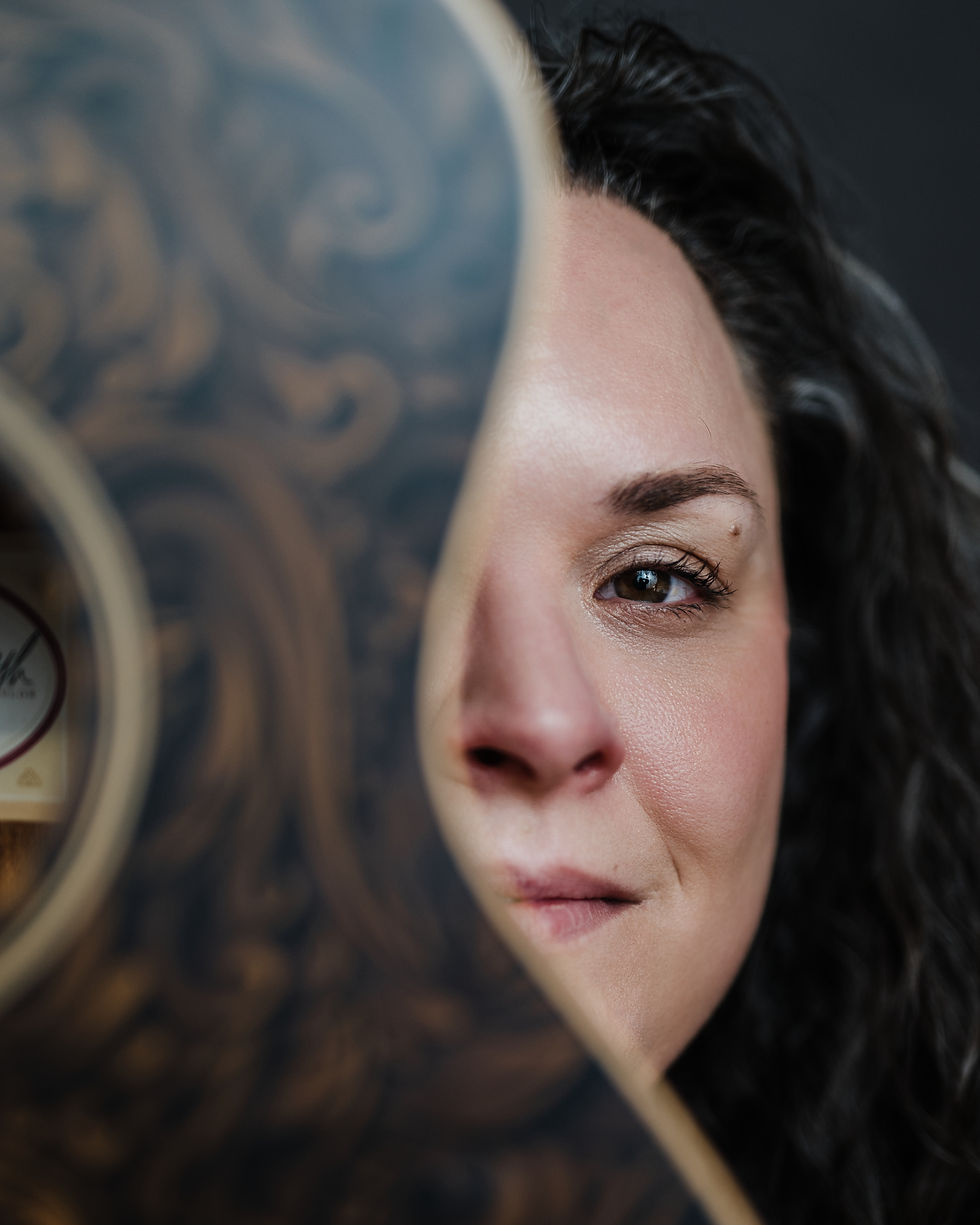
They told me I was too blunt. Too loud. Too emotional. That I wore my heart on my sleeve. That I talked too much. That I had so much potential, if only I could just... tone it down a little.
I was a kid and I can still hear those words now. I was learning that who I was, naturally, was too much.
I spent years trying to adjust, controlling my volume, rephrasing my bluntness so it landed softer. I learned how to read people really well, what was important to them and adjusted myself accordingly. I organized myself in ways that looked “appropriate,” building a version of me that could finally, maybe, fit.
It worked, kind of, on the outside, I looked fine, happy, even.
Maybe I even convinced myself I was.
What is really was… Masking.
— WHAT IS MASKING, ACTUALLY? —
Define It Before We Debate It
Masking is the process of suppressing, hiding, or adjusting your natural behaviors, reactions, and personality traits in order to fit in, avoid judgment, or feel safe in a social environment.
It’s most commonly discussed in the context of autism and ADHD, but honestly? It’s something that millions of people do, diagnosed or not, every single day. Because we live in a world that has very specific ideas about how we are supposed to act, feel, talk, and exist. And if you fall outside those norms, you learn fast: adapt or face the consequences.
So you adapt. You mask. And for a while, it works.
— THE GOOD —
The Good: Why Masking Exists (And Why It Made Sense)
I want to be clear masking isn’t stupid, it’s not a weakness, it’s survival intelligence.
Here’s what masking actually does, at least in the beginning:
1. It creates protection.
When you’re different, when your brain works differently, when your emotions run hotter, when you process the world in ways that confuse or overwhelm the people around you, standing out can be genuinely dangerous. Socially dangerous, or sometimes physically dangerous, and masking takes the target off your back. It decreases uncomfortable situations. It can stop bullying before it starts. It gives you a way to pass as “normal” when normal is expected.
For a lot of us, masking was a response to a world that clearly wasn’t made for us.
2. It’s a social blueprint.
When you don’t naturally pick up on unspoken social rules, when the things that come easily to other people feel like a foreign language, masking gives you a script. You watch how other people do it. You learn the rules. You follow the blueprint, and suddenly you can make friends. You can be part of something. You can feel like you belong, even if the version of you that belongs isn’t entirely real.
For neurodivergent individuals especially, this matters. We often spend years studying social dynamics the way other people study for exams, maybe even marveling at how others make it looks so easy.
3. It builds something real, even if it’s borrowed.
“Fake it till you make it” gets a bad reputation. But there’s something true in it. When you act confident, you sometimes become more confident. When you practice a skill, even if it’s a skill that shouldn’t require practice, like making eye contact or modulating your voice, you get better at it. Masking can build genuine capability, genuine perseverance, a work ethic that comes from the sheer determination to not give up on belonging.
That resilience? It’s real, even if the method was exhausting.
“Masking wasn’t weakness. It was the most sophisticated coping strategy you had.”
— THE BAD —
The Bad: What Masking Costs You
Masking has a price, and the longer you pay it, the more it costs.
1. It is exhausting in a way that sleep won’t fix.
Think about what masking actually requires. You’re monitoring yourself constantly. Every sentence before you say it. Every reaction before you show it. Every instinct before you act on it. You’re running a background program 24/7, checking, adjusting, correcting, apologizing.
I used to default to routines and black-and-white decisions not because I’m simple, but because anything that required more thinking was too much on top of everything else I was already managing. My brain was full. It was full of the mental load of performing a version of myself that didn’t come naturally.
That exhaustion isn’t laziness. It’s not a character flaw. It’s the direct result of trying to be two people at once, who you are, and who you think you need to be.
I remember moving to Colorado and thinking, no one knows me here, I can be anything I want. Making a list of all the things I was going to change about myself, so I could make friends easily, it didn’t last long. I also remember my biggest mistake, I was so desperate to make friends and have an adult conversation, I over shared. Not only was I ghosted, my son was too.
2. It sends a message you never stop hearing.
Every time you mask, your nervous system registers the same thing: who I am is not okay.
Not consciously, but underneath, in the body, in the quiet, the message lands. You are too much. You need to be different. You need to be less, and you hear it so many times, for so long, that eventually you stop needing anyone else to say it. You say it to yourself.
That’s when masking stops being a strategy and starts being a story. It’s one of the most damaging stories you can carry.
3. It cuts you off from yourself.
Here’s what I didn’t understand when I was younger: every time I stuffed down a reaction, rephrased an honest thought, or controlled an emotion that felt “too big” for the room, I wasn’t just hiding it from other people. I was losing access to it myself, I was numbing myself.
You cannot selectively suppress your personality. When you bottle up the parts of yourself that feel unsafe to show, you bottle up all of it, the creativity, the fire, the intuition, the joy. You stop expressing, and slowly, you start disappearing.
“You cannot selectively suppress your personality. When you bottle the parts that feel unsafe, you bottle all of it.”
— THE UGLY —
The Ugly: What Prolonged Masking Does to Your Body and Mind
This is the part nobody talks about, because we live in a world that praises those who hold it together, who seem fine, who manage and show up.
We don’t talk about what that costs.
1. Prolonged masking keeps your body in survival mode.
When you are constantly monitoring, adjusting, and performing, your nervous system is working. It is on alert. It is scanning for threat and over time, that doesn’t turn off. Your body doesn’t know the difference between a real threat and the social threat of being seen as “too much.” It registers danger either way.
The result? Depression. Chronic anxiety. The inability to rest, really rest, even when you’re alone. Hypervigilance that follows you everywhere. A baseline tension you can’t explain and can’t shake because your body has been in survival mode so long it forgot how to be anywhere else.
This isn’t a personality flaw. This is a physiological response to years of suppression.
2. Masking failure hits harder than it should.
Masking is impossible to maintain perfectly, you will slip. You will be too loud in a meeting, too blunt with a friend, too emotional in a moment that didn’t call for it, and when that happens, when the mask cracks for even a second, the shame spiral is brutal.
I know this one personally. The amount of mental energy I spent after those moments, going over and over what I said, wishing I could have just held in my thoughts for just a second before I word vomited what everyone was thinking but knew not to say out loud. The exhaustion wasn’t just from the masking. It was from having to explain myself over and over when someone misunderstood me. From the look on someone’s face that told me I’d gotten it wrong again.
That shame isn’t proportional, it’s accumulated. It’s every time you were told you were too much, playing back on a loop.
The real ugly: We Built a World that Demands this.
Here’s what I believe:
The problem isn’t that you masked. The problem is that you had to.
We live in a society that has curated very specific norms, for how we should sound, how we should feel, how much space we should take up, and if you fall outside those norms, it is treated as your problem to solve, your job to conform, your responsibility to manage.
But what if we built a world that taught people to celebrate difference instead of conform to sameness? What if neurodivergence was treated as a different way of experiencing the world, not a deficit to correct? What if the girl who was too blunt, too loud, too emotional was met with: “We’re glad you’re here. The world needs your kind of honest.”
That’s the world I’m working toward.
“The problem isn’t that you masked. The problem is that you had to.”
— THE REFRAME —
Taking Off the Mask, It’s Your Choice.
I want to say something to you, if you are reading this and recognizing yourself in every paragraph.
I am not telling you what you should do. I’m simply trying to show you that you have a choice. The mask is heavy, and you’ve been carrying it for a long time. You are allowed to put it down. You are allowed to decide it doesn’t work for you anymore. You are allowed to keep parts you like and remove parts that are too much. You are allowed to make the rules.
Not all at once. Not in front of everyone. But here, in this work, in the brave space of actually expressing what’s been bottled up, through music, through voice, through finally letting yourself be seen, you get to start practicing what it feels like to just... be yourself.
Not the adjusted version. Not the appropriate version. You.
Your too much. Your too blunt. Your too loud. Your too emotional.
Your power.
— CHALLENGE FOR THE READER —
This Week’s Invitation
Notice the mask.
Not to rip it off, just to notice it. This week, pick one moment when you catch yourself adjusting, shrinking, or holding back who you are, don’t judge it, don’t perform a different response. Just notice: I’m masking right now. What am I afraid will happen if I don’t?
You don’t have to answer that question out loud. But sitting with it, even for thirty seconds, is the beginning of something.
Ready to learn more?
If this resonated, if you read this and thought “this is me,” subscribe to hear more. Get weekly insights on how you can express, reclaim and celebrate yourself, exactly as your are so you can become Found, Unfiltered and Free.
You don’t have to figure this out alone, the work I do isn’t about fixing you. It’s about helping you find your way back to yourself, through music, through expression, through finally getting to be the full, unedited version of you in a space that celebrates it.
— FAQ —
Frequently Asked Questions About Masking
What does masking mean in mental health?
Masking in mental health refers to the process of hiding or suppressing your authentic behaviors, emotions, and personality traits in order to fit social norms or avoid negative reactions. It’s most commonly discussed in relation to ADHD and autism, but many people engage in masking without a formal diagnosis.
Is masking always harmful?
Not always, especially in the short term. Masking can serve a protective purpose, help with social navigation, and even build certain skills. The harm comes from prolonged, sustained masking over years, which can lead to chronic anxiety, depression, identity loss, and physical exhaustion.
How do I know if I’m masking?
Common signs include: feeling exhausted after social interactions, not knowing who you “really are,” monitoring your behavior constantly, feeling like you perform a version of yourself for others, and experiencing shame when you act naturally and it doesn’t land the way you intended.
Can music therapy help with masking?
Yes and it is a powerful tool. Music therapy creates a non-verbal, non-judgmental space where expression happens outside of social performance. When we use music to express what’s been suppressed, they often access parts of themselves they’ve been masking for years. It’s not about performing, it’s about finally letting out what’s been held in.


Comments